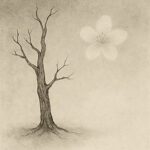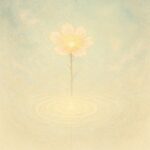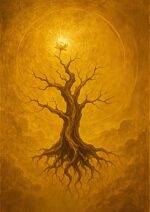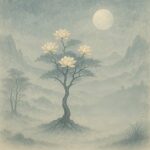
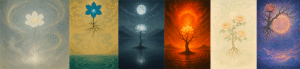
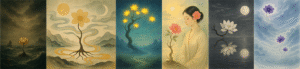
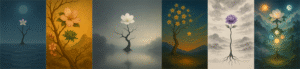




The poems of “The Rootless Tree” express a fundamental force rooted in harmony with heaven and earth, the cyclical flow of yin and yang, and the infinite potential of existence。
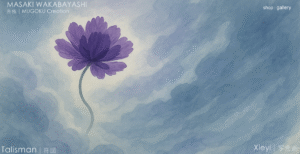
This painting is an expressive “Xieyi” in the tradition of “futu” (spiritual diagrams), passed down for generations in Wudang Mountain, China. It is drawn through a technique where energy flow (xingqi) channels the internal intention into visual form。
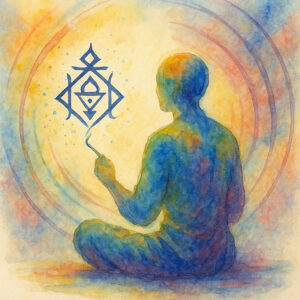 In the Taoist world, there exist spiritual and symbolic images called “futu”。
These are a type of talisman—not merely religious items, but expressive spiritual paintings that act directly on the mind of the viewer。
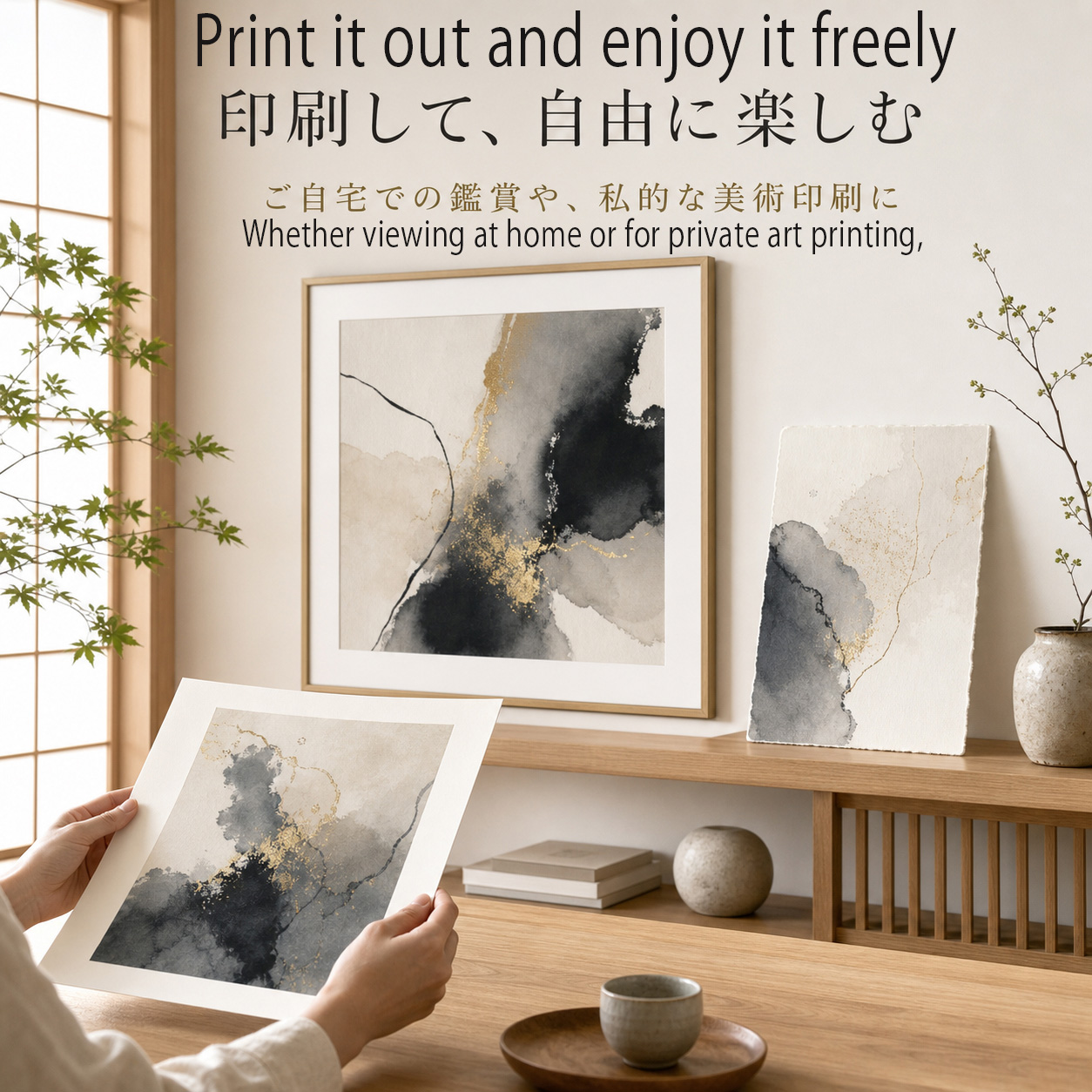
Since ancient times, many people have placed these Taoist-style “Xieyi” and futu in their homes, studies, or bedrooms, wishing for longevity, health, auspiciousness, and family harmony. Viewing such paintings was not just aesthetic appreciation, but an act of inviting the presence of the Dao into one’s life and tuning the body and mind。
Thus, “Xieyi” is more than artistic expression—it is a medium that bridges the spirit, life, and harmony with the universe。
This kind of artwork is not meant to be seen only with the eyes, but felt with the heart。
It communicates with the Dao, resonates with the qi of nature, and quietly stirs the viewer’s inner self。
Futu and “Xieyi” continue to live on from ancient times to this day as “sacred images that speak to the soul.”
Below, we present the original text of the philosophical poem “The Rootless Tree,” along with a modern Japanese translation and interpretation。
※ The author of “The Rootless Tree,” Zhang Sanfeng (1247–?), is also renowned as the founder of Tai Chi, and it is said that he applied the essence of this work to Tai Chi. As an additional note, we include an interpretation connecting this to the Tai Chi tradition of Wudang Mountain.
The Rootless Tree・Outer Verse 12
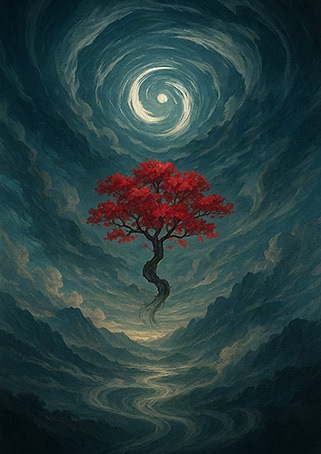
▶Original Text
無根樹,花正紅,行動無常,隨氣運行。陰陽相依,氣運無窮,無為無欲,自然為道。
▶Modern Translation
A crimson flower crowns the rootless tree.Every action changes unceasingly, riding the flow of Qi.Yin and Yang rely on one another; Qi’s current never ends.When free of striving and desire, Nature itself becomes the Way.
▶Interpretation
[無根樹,花正紅] Crimson bloom—detached yet powerful grace.[行動無常,隨氣運行] All deeds are impermanent—guided by Qi.
[陰陽相依,氣運無窮] Opposites depend; Qi’s cycle is endless.
[無為無欲,自然為道] Without force or craving, Nature is the Dao.
▶Interpretation related to Tai Chi
Freedom from fixation fosters supple power.
Movement generated by Qi appears effortless.
Dynamic balance keeps energy perpetual.
Ultimate stage is spontaneous, desireless motion.