




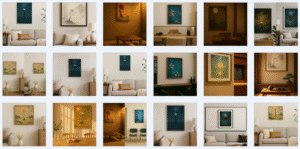
The Contemporary Revival of Futu — When Xieyi Awakens as Conceptual Art
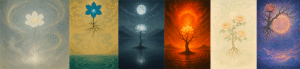
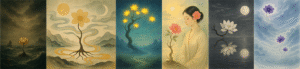
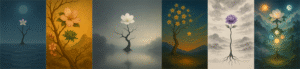
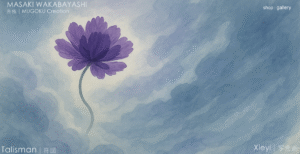
The artist revives futu—spiritual and symbolic images handed down from ancient China—and reconstructs them as contemporary works of Xieyi art. Through a free and expressive approach to painting, these works go beyond purely visual representation to bring Qi, symbolism, and intention together within a single composition.
These works are intended not only to be viewed, but also to invite subtle changes in the atmosphere of a space and in the viewer’s awareness. While drawing upon the philosophy of futu once used in temples and places dedicated to health and spiritual cultivation, they do not simply reproduce images from the past. Instead, they emerge as a new form of art that responds to the spiritual and inner sensibilities of people today.
The controlled spontaneity of the brushwork and the stillness within the expression symbolically convey the movement of Qi, the rhythms of Yin and Yang, and the geometry of the soul.
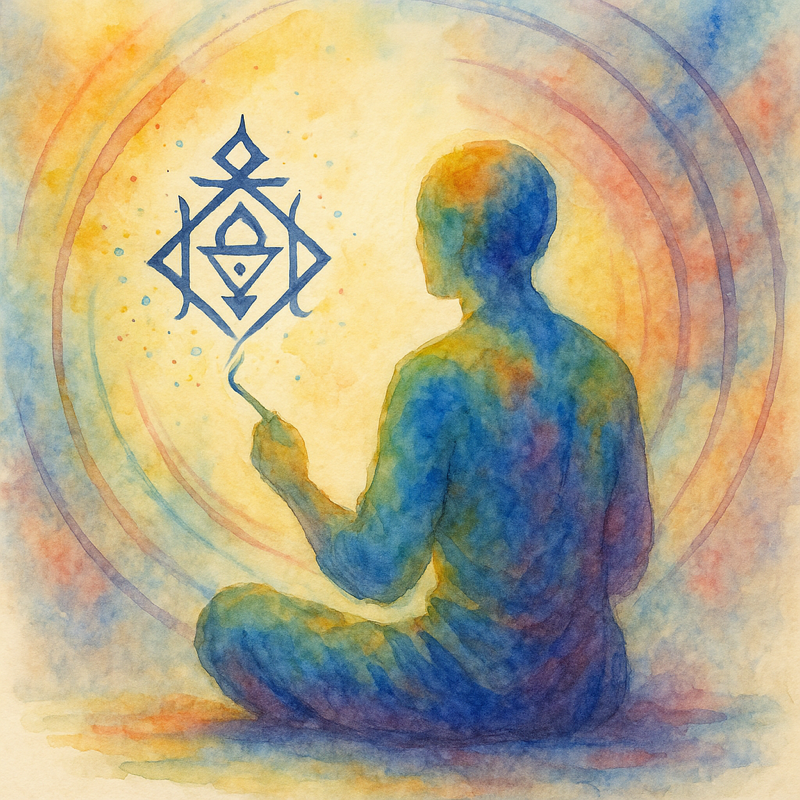
Conceived as a talismanic symbol, a painting, and a Code of Being, the work brings Xieyi to life in the present as “art that acts upon perception.”
“The Code of Being” — a cipher, a secret sign
It is drawn not with words, but through breath and movement.
A quiet rhythm flows beneath the brush,
an unseen order gives form to silence.
Like a compass pointing toward an inner direction,
it bears the sign of the soul entering space.
It is not art intended merely to be “seen,”
but art intended to be “felt.”
Xieyi Painting — The Art of Expressing the Heart Rather Than Form
Xieyi painting is a tradition within Chinese art that places greater importance on expressing spirit, feeling, and the essence of life than on reproducing forms with exact realism.
Rather than precisely copying the outward appearance of nature, Xieyi seeks to capture the life and presence within it. The vitality of a blooming flower, the spiritual presence of a mountain, or the breath of the wind may be expressed through free and powerful brushwork.
What this art expresses is not limited to visible form. It also gives form to what is perceived and felt through the heart.
Xieyi is not merely an art of imitation, but an art of discovering what lies within its subject. What is expressed is both the spirit of the subject and the inner state of the artist.
Xieyi as Futu — Imagery Expressing Qi and Spirit
When Xieyi is created as futu, it becomes more than a visual expression: it becomes symbolic imagery representing intention, Qi, and spiritual resonance.
These works are intended to invite viewers to reflect upon harmony within space, the mind, and the spirit. Each stroke incorporates themes drawn from the Taoist view of the universe, the principles of nature, and inner cultivation.
The work is conceived as a visual mantra or a symbolic map of energy. It is a painting presented as a “living symbol” that may evoke ideas of harmony, vitality, and insight in the viewer.
Xieyi Painting — Giving Visible Form to Yi, the Activity of the Heart and Mind
A Distinctive Work Born from a Single Yi
Xieyi is an art that draws out the yi—the intention, meaning, or inner essence—contained within a poem or verse and gives it visible form through a distinctive creative process. The original expression underlying this work was created as an individual artistic creation by the artist.
The digital file offered for sale allows the artwork to be enjoyed through high-resolution fine-art printing. The same artwork file may be sold to multiple purchasers and is not offered as a one-of-a-kind work or a limited edition.
Purchasing the file does not transfer copyright ownership. The purchaser receives permission to view the artwork and produce fine-art prints for private use, within the scope established by the Digital Artwork Download Terms of Use.
What Is Xieyi? — The Soul of East Asian Art That “Expresses Meaning and Spirit”
Xieyi is one of the important aesthetic concepts found in traditional Chinese and East Asian painting and calligraphy.
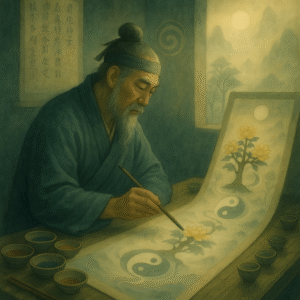
In the word Xieyi, xie means “to write,” “to depict,” or “to express,” while yi refers to intention, meaning, and the essential activity of the heart and mind. Its fundamental principle is therefore to express not merely outward form, but the inner essence or intention behind it.
The purpose of Xieyi is not simply to reproduce what is seen. It seeks to express through painting the spirit, vitality, and emotional inspiration contained within its subject—in other words, its living presence.
This artistic principle follows a direction different from realism, which emphasizes the faithful representation of outward appearance. In Xieyi, visible form serves as a means through which the essence of the subject and the inner state of the artist may be expressed.
Its Affinity with Taoist Thought — A Deep Connection with Ziran and Effortless Action
The aesthetics of Xieyi are deeply connected with the concept of the Tao found in the philosophies of Laozi and Zhuangzi.
In particular, the Taoist ideal of wuwei ziran—refraining from excessive contrivance and respecting the natural course of things—resonates with the Xieyi approach of releasing attachment to exact form and allowing the brush to follow its natural flow.
Painting is understood not as a demonstration of technique, but as an expression of the movement of Qi and the emergence of inner intention.
Rather than being bound by predetermined forms, Xieyi emphasizes how the intended meaning enters the picture through the circulation and movement of Qi. In this approach, the Taoist aesthetic of “form within the formless, reality within emptiness” becomes visible.
Futu and Xieyi — Symbolic Art That Makes Ideas Visible
Within the world of the Tao are spiritual and symbolic images known as futu.
Although futu have a historical background as talismanic forms, they may also be understood as works of symbolic art created through an expressive approach related to Xieyi. Rather than realistically depicting physical objects, they symbolically express ideas, spirituality, views of nature, and visions of the universe. In this respect, their mode of expression is deeply connected with the philosophy of Xieyi.
The strength and movement of Qi suggested by the brushwork are composed as an artistic expression intended to engage the viewer’s senses and inner awareness.
Since ancient times, people have displayed Taoist Xieyi paintings and futu in their homes, studies, and bedrooms while expressing wishes for longevity, health, good fortune, and harmony within the family. This was not simply a way of appreciating beauty. It was also a cultural practice through which people brought the philosophy of the Tao into daily life and reflected upon their physical, mental, and spiritual well-being.
Xieyi as an Expression Connecting Spirit and Everyday Life
In this way, Xieyi has been passed down not merely as a form of pictorial expression, but as an art concerned with harmony among the human spirit, everyday life, nature, and the universe.
- It gives visual expression to Qi,
- gives form to the formless,
- accepts the natural flow of things, and
- establishes the state of the heart and mind within the picture.
Above all, it has been embraced as an art through which people may reflect upon a Taoist way of living and the circulation of Qi, bringing those ideas into the spaces of everyday life.
Xieyi Is Not Merely Seen with the Eyes, but Felt with the Heart
Xieyi is connected with the philosophy of the Tao and resonates with the Qi of nature. It is an art that seeks to move the viewer inwardly and quietly.
From ancient times to the present, futu and Xieyi painting have carried forward the idea of “spiritual images that speak to the human soul,” while continuing to live through new forms of contemporary expression.