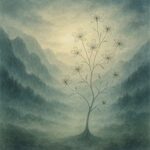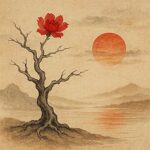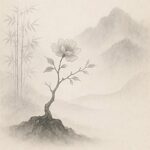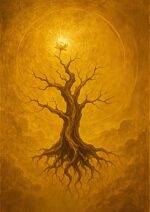
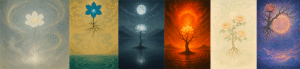

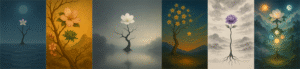




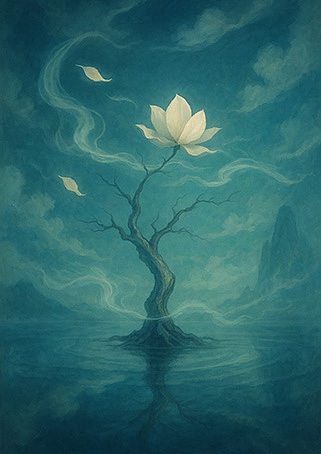
The poems of “The Rootless Tree” express a fundamental force rooted in harmony with heaven and earth, the cyclical flow of yin and yang, and the infinite potential of existence。
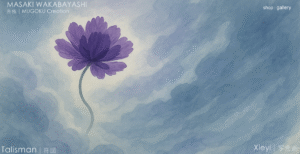
This painting is an expressive “Xieyi” in the tradition of “futu” (spiritual diagrams), passed down for generations in Wudang Mountain, China. It is drawn through a technique where energy flow (xingqi) channels the internal intention into visual form。
 In the Taoist world, there exist spiritual and symbolic images called “futu”。
These are a type of talisman—not merely religious items, but expressive spiritual paintings that act directly on the mind of the viewer。
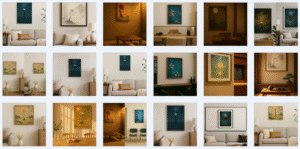
Since ancient times, many people have placed these Taoist-style “Xieyi” and futu in their homes, studies, or bedrooms, wishing for longevity, health, auspiciousness, and family harmony. Viewing such paintings was not just aesthetic appreciation, but an act of inviting the presence of the Dao into one’s life and tuning the body and mind。
Thus, “Xieyi” is more than artistic expression—it is a medium that bridges the spirit, life, and harmony with the universe。
This kind of artwork is not meant to be seen only with the eyes, but felt with the heart。
It communicates with the Dao, resonates with the qi of nature, and quietly stirs the viewer’s inner self。
Futu and “Xieyi” continue to live on from ancient times to this day as “sacred images that speak to the soul.”
Below, we present the original text of the philosophical poem “The Rootless Tree,” along with a modern Japanese translation and interpretation。
※ The author of “The Rootless Tree,” Zhang Sanfeng (1247–?), is also renowned as the founder of Tai Chi, and it is said that he applied the essence of this work to Tai Chi. As an additional note, we include an interpretation connecting this to the Tai Chi tradition of Wudang Mountain.
The Rootless Tree・Verse 51
▶Original Text
無根樹,花正風,隨風起舞,氣轉無形。心如止水,意走無聲,有無之際,道在其中。
▶Modern Translation
A warm flower blooms on the rootless tree;
Spring wind gently touches all without division.
When yin and yang meet in balanced grace,Qi flows smooth and deep, serene and clear.
▶Interpretation
1.[無根樹,花正溫] A warm bloom represents inner softness and quiet strength.
2.[春風拂物,無分彼此] The spring breeze caresses all things evenly—no self or other.
3.[陰陽相交,氣行清澈] When yin and yang join harmoniously, qi becomes transparent and free-flowing.
4.[無根而穩,溫柔中定] Though rootless, there is calm; stability arises through gentleness.
▶Interpretation related to Tai Chi
•Softness nourishes strength: The flower signifies yielding power (柔), central to internal martial arts.
•Harmonized yin and yang produce qi that flows like water—essential to movements like cloud hands.
•Spring wind metaphor reflects the principle of non-resistance (bu kang 不抗).
•Stability and clarity do not come from force, but from balance, softness, and empty intention (xu yi 虛意).