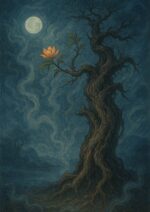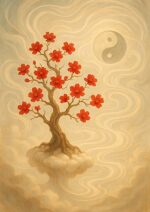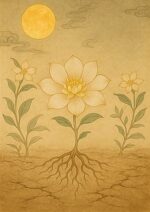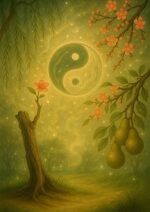
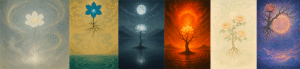
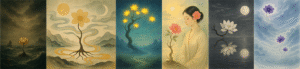
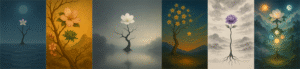




The poems of “The Rootless Tree” express a fundamental force rooted in harmony with heaven and earth, the cyclical flow of yin and yang, and the infinite potential of existence。
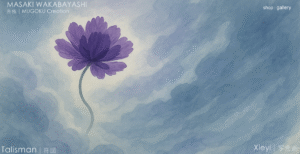
This painting is an expressive “Xieyi” in the tradition of “futu” (spiritual diagrams), passed down for generations in Wudang Mountain, China. It is drawn through a technique where energy flow (xingqi) channels the internal intention into visual form。
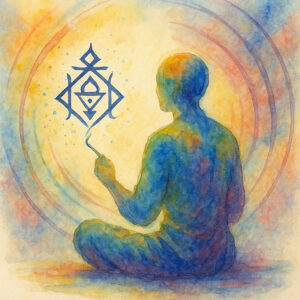 In the Taoist world, there exist spiritual and symbolic images called “futu”。
These are a type of talisman—not merely religious items, but expressive spiritual paintings that act directly on the mind of the viewer。
Since ancient times, many people have placed these Taoist-style “Xieyi” and futu in their homes, studies, or bedrooms, wishing for longevity, health, auspiciousness, and family harmony. Viewing such paintings was not just aesthetic appreciation, but an act of inviting the presence of the Dao into one’s life and tuning the body and mind。
Thus, “Xieyi” is more than artistic expression—it is a medium that bridges the spirit, life, and harmony with the universe。
This kind of artwork is not meant to be seen only with the eyes, but felt with the heart。
It communicates with the Dao, resonates with the qi of nature, and quietly stirs the viewer’s inner self。
Futu and “Xieyi” continue to live on from ancient times to this day as “sacred images that speak to the soul.”
Below, we present the original text of the philosophical poem “The Rootless Tree,” along with a modern Japanese translation and interpretation。
※ The author of “The Rootless Tree,” Zhang Sanfeng (1247–?), is also renowned as the founder of Tai Chi, and it is said that he applied the essence of this work to Tai Chi. As an additional note, we include an interpretation connecting this to the Tai Chi tradition of Wudang Mountain.
The Rootless Tree・Chapter 21
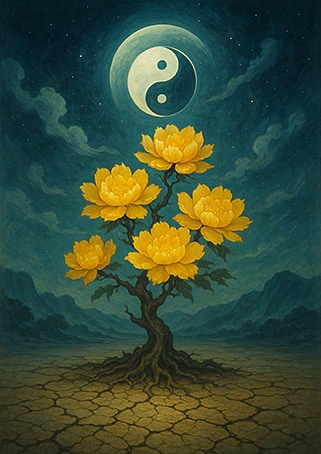
▶Original Text
無根樹,花正黃,產在中央戊己鄉。東家女,西家郎,配合夫妻入洞房。黃婆勸飲醍醐酒,每日醺蒸醉一場。這仙方,返魂漿,起死回生是藥王。
▶Modern Translation
The yellow flower blooming on the rootless tree is born from the soil spirit of the center (Wu and Ji).
An eastern maiden and a western youth enter the bridal chamber; the Yellow Lady serves the supreme liquor.
Drinking it daily, they become joyfully intoxicated.
This elixir, the “Soul-Returning Wine,” revives even the dead.
▶Interpretation
• Represents the union of yin and yang in the center (Earth element).
• The soul-returning wine signifies spiritual rejuvenation and rebirth.
▶Interpretation related to Tai Chi
This passage embodies the internal harmony of yin and yang, mirrored in Tai Chi’s motion-intention balance.
The elixir reflects the inner satisfaction and renewal that arise through consistent Tai Chi practice.
⸻