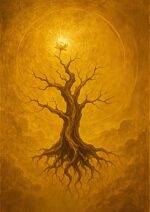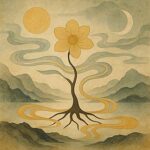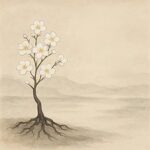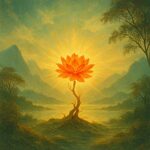
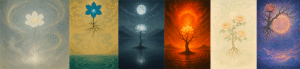
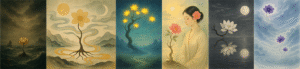
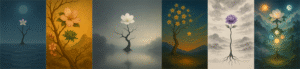




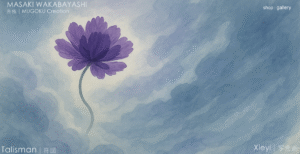
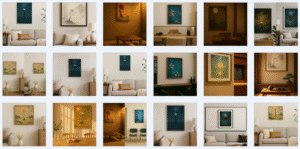
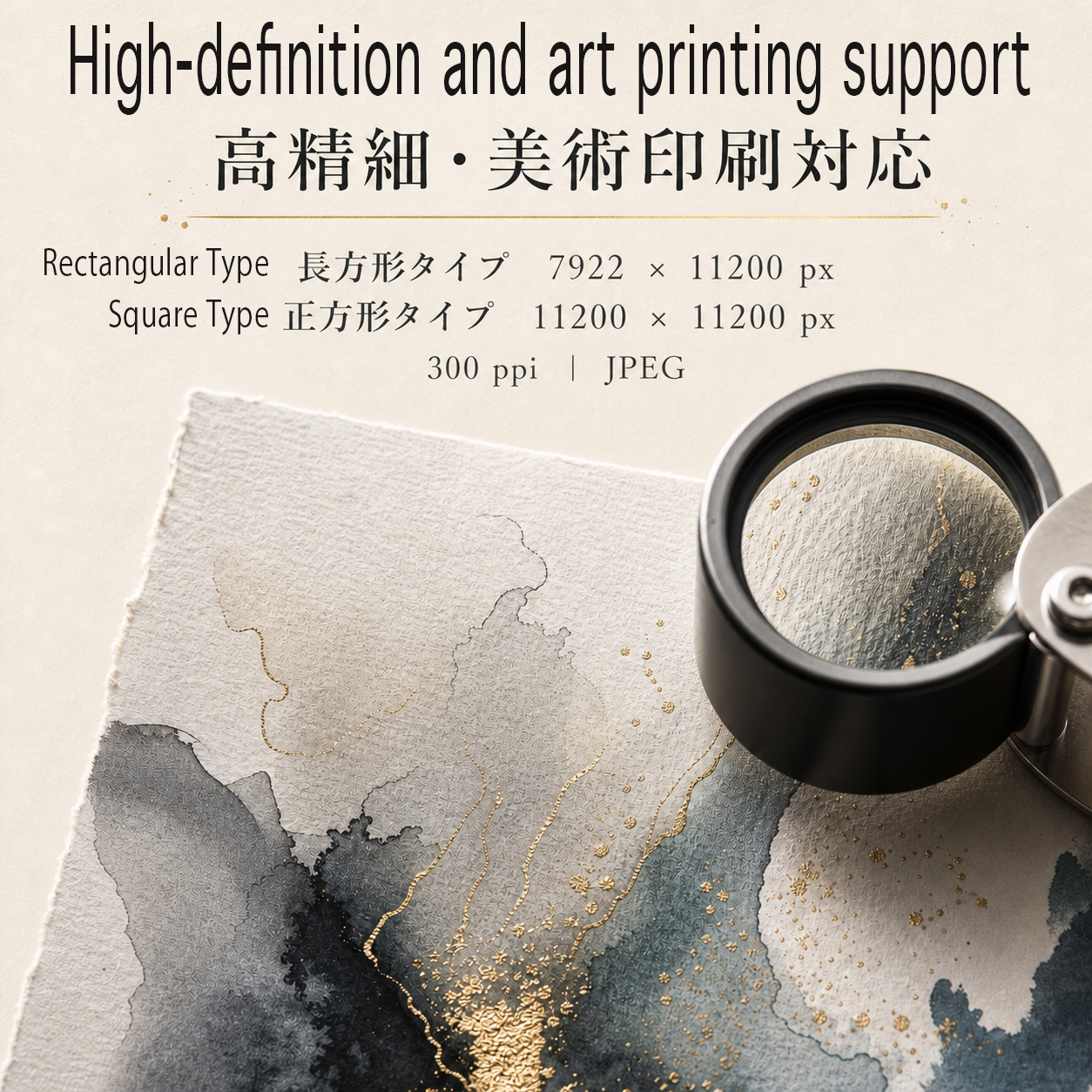
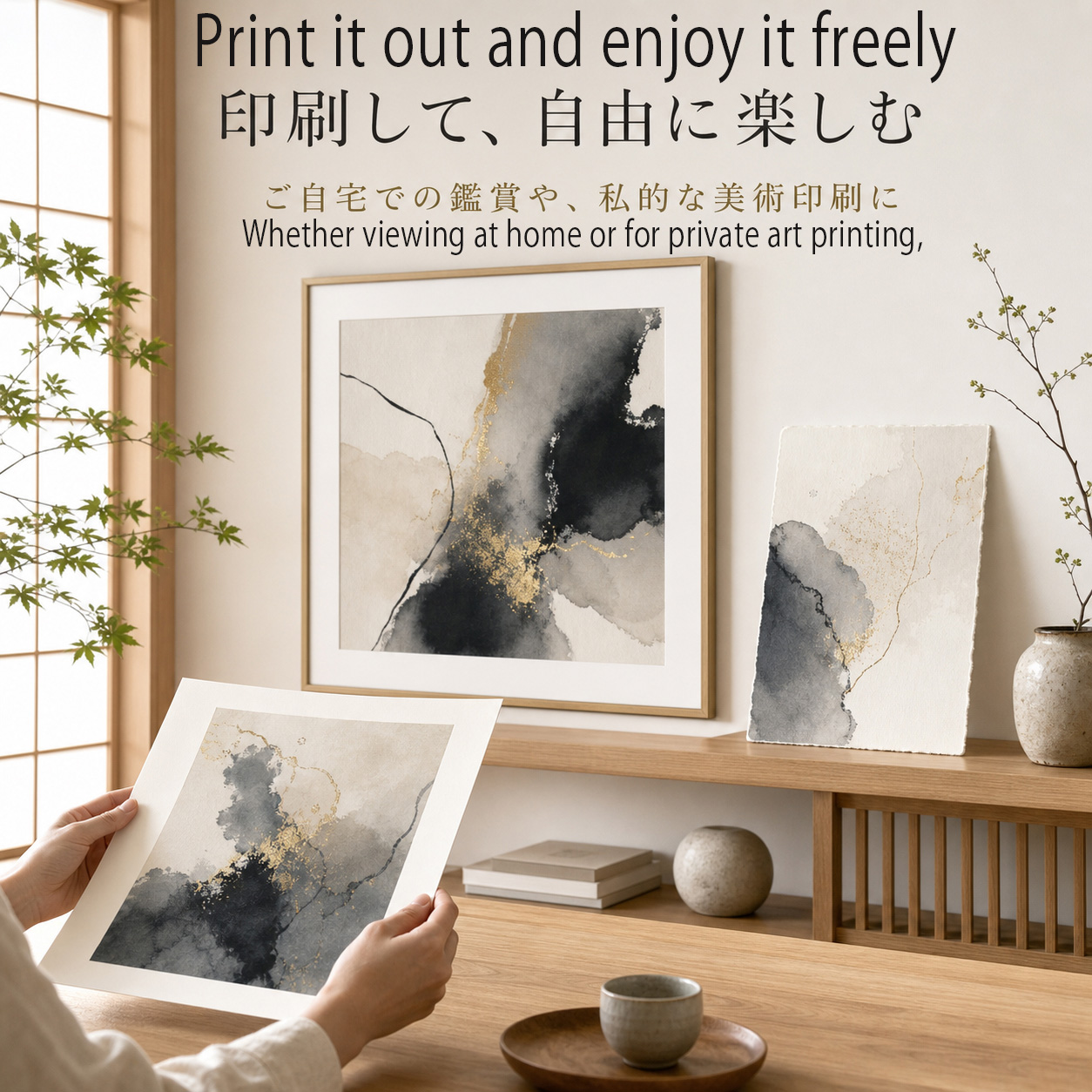
The poems of “The Rootless Tree” express a fundamental force rooted in harmony with heaven and earth, the cyclical flow of yin and yang, and the infinite potential of existence。
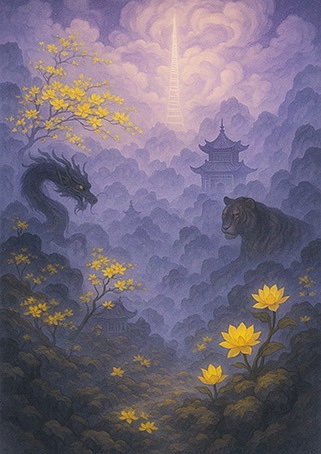
This painting is an expressive “Xieyi” in the tradition of “futu” (spiritual diagrams), passed down for generations in Wudang Mountain, China. It is drawn through a technique where energy flow (xingqi) channels the internal intention into visual form。
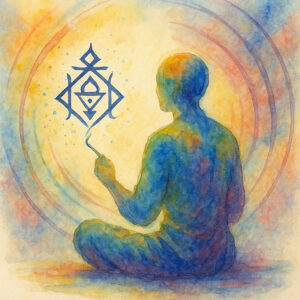 In the Taoist world, there exist spiritual and symbolic images called “futu”。
These are a type of talisman—not merely religious items, but expressive spiritual paintings that act directly on the mind of the viewer。
Since ancient times, many people have placed these Taoist-style “Xieyi” and futu in their homes, studies, or bedrooms, wishing for longevity, health, auspiciousness, and family harmony. Viewing such paintings was not just aesthetic appreciation, but an act of inviting the presence of the Dao into one’s life and tuning the body and mind。
Thus, “Xieyi” is more than artistic expression—it is a medium that bridges the spirit, life, and harmony with the universe。
This kind of artwork is not meant to be seen only with the eyes, but felt with the heart。
It communicates with the Dao, resonates with the qi of nature, and quietly stirs the viewer’s inner self。
Futu and “Xieyi” continue to live on from ancient times to this day as “sacred images that speak to the soul.”
Below, we present the original text of the philosophical poem “The Rootless Tree,” along with a modern Japanese translation and interpretation。
※ The author of “The Rootless Tree,” Zhang Sanfeng (1247–?), is also renowned as the founder of Tai Chi, and it is said that he applied the essence of this work to Tai Chi. As an additional note, we include an interpretation connecting this to the Tai Chi tradition of Wudang Mountain.
The Rootless Tree・Chapter 13
▶Original Text
無根樹,花正多,遍地開時隔愛河。難攀折,怎奈何?歩歩行行龍虎窩。採得黃花歸洞去,紫府題名永不磨。笑呵呵,白雲阿,准備天梯上大羅。
▶Modern Translation
The flowers on the rootless tree bloom in profusion, stretching to the ends of the earth.
Beyond the river of affection lies a realm not easily reached.
Each step forward enters the den of dragons and tigers.
If you pluck the yellow flower and return to the cave,
And carve your name in the violet palace, it shall never fade.
Laughing like a drifting cloud, prepare the ladder to Heaven, and reach the realm of Grand Completion.
▶Interpretation
As cultivation deepens, one enters realms of immense power—the dragon and tiger symbolizing this dynamic force.
Marking one’s name in the violet palace represents attainment.
The final goal: union with the cosmic, transcending mortality.
▶Interpretation related to Tai Chi
As practice advances, the dragon and tiger within awaken—
symbolizing awakened internal power and integration with the universal Dao.
The ultimate goal is Grand Unity: body, mind, and cosmos in harmony.